The
shadow of the inner child that kills us
Keywords: personality, psyche,
psychotherapy, wounded child, inner child, lucidity, higher self, ego
The
inner battlefield of dominant and repressed (sub)-personality programs made
lucid and quantifiable.
By Luc Sala
2012-08-24
http://www.lucsala.nl/psyche.htm see also: www.lucsala.nl/lucidity.htm
Synopsis:
Using divination to gauge the parameters of the
psyche using the inner child-mask(s) model is very useful in detecting (potential)
conflicts between layers and (sub)-personalities of the psyche. These often
lead to somatic or psychical problems or unwanted behavioural patterns. In this essay the psychological model of ego/mask(s)
and(wounded child is outlined and developed and numerical data concerning their
relationship are used to illustrate this model. These data are obtained by
radionics/dowsing methods and therefore have a subjective aspect, but does give reproducible
results. The outcome of this diagnostic procedure (Lucidity method) yields
effective result in understanding the working of the psyche. This method has been used and validated in
hundreds of cases and is here also applied to historical people. The data on
the different mind-states/programmes/subpersonalities
have shown that although our body and mind have the same hardware, the
different programmes (subpersonalities/masks) use
this hardware different, people can have a different IQ, sexual orientation etc.
in different (sub)-personalities. Additionally
the Lucidity method can indicate the potential of various therapies to help recognize
and integrate the wounded child, identify the masks and the inner conflicts and
free/release the inner child. This model is explained, illustrated by case
history data, analysis of historical figures, comparison of data concerning
spiritual teachers/gurus,
and compared with philosophical, therapeutical,
religious and magic worldviews. Analysis of the numerical data for normally intangible and
vague qualities like spiritual resonance, emotional IQ, sexual orientation, happiness,
beauty and much more also gives insight into how the psyche develops and how
ego and personality in growing up and experiencing the outside realities diverge
from the original soul/higher self scenario and how the resulting differences yield
valuable insights in one’s mental and physical health and happiness. The
approach also sheds light on how psychotherapy works and could work.
The main
thesis of this essay is:
Most illnesses and problems in our life stem from the repressed inner
child (inner self) that wants to be heard and is suppressed by the mask(s) or
personalities we have developed as a defence-mechanism. Understanding,
measuring and analyzing the parameters of this ego-system and the underlying
inner child yields valuable insights for therapy and healing.
The
methodology used (lucidity method) is based on the assumption, that we can (by
divination) measure even intangible parameters, differentiate them for the
personalities or masks and so indicate potential inner conflicts. Feedback is
essential for actual cases and has validated the method in many cases, but the
method itself can also be used to analyse deceased ones.
The Ancient Greek
aphorism "Know thyself" (Greek: γνώθι
σεαυτόν or gnothi seauton) was inscribed in golden letters at the lintel of
the entrance to the
And can we
know ourselves by ourselves, or do we need the help of others. The
In modern
times we have seen psychotherapy, psychology and a host of related disciplines
evolve into tools for self-knowledge. Psychological tests, personality type matrices
like the Enneagram, Myers-Briggs indices, self-help programs, psychedelics,
inner child and wounded child programs, one can spend a lifetime discovering
oneself.
The
sobering truth is, however, that very few people reach the level of
self-knowledge and awareness that results in overcoming the basic programming
we so easily refer to as the ego or believe to be the personality, the mask we
present to the world (and believe to be ourselves). Many professional
psychologists now acknowledge, that even the most advanced and extensive
psychological tests give little insight in the way a person acts and will act
in real-life situations. Even as psychological testing is still very popular in
the corporate world, the results are indicative at best, the top performers
emerge in the reality of human interaction, the problem-makers are rarely
weeded out by such tests. The “human touch” in selecting personnel and HRM
functions is essential.
Something
is missing in our perception of the human condition, in how we perceive our
psyche. Psychology, with Wundt, Pavlov, James, Freud, Jung, Adler, Perls, Maslow, Rogers, Piaget, Skinner, Grof
and so many others has discovered a lot, but has modern science really
uncovered more than what the Zen-masters, the Vedic Rishi’s
or Plato understood? Were philosophers like Hegel, Husserl, Heidegger, Merleau-Ponty on a really new track with their
exploration of phenomena
(what presents itself to us in conscious experience), is there really a schism
between the idealists and the realists if we would truly understand the Veda’s
and Upanishads. Weren’t Kant and Hume not both trying to understand what is
beyond empiricism and rationalism, trying to define or isolate the deep reality
from the perception we know is subjective at best and both touching on that
vast realm of magic and transcendental knowing we cannot perceive with our
senses or rationalize with our mind, but sense exists. For me the history of
philosophy and science is an exciting story, but also a cycle of discovery and
rediscovery, the Uruburos
chewing its tail, finding the truth and the love underlying all realities anew
all the time. Therefore, what follows is not new, it’s just my truth, my path,
my perspective on something which is beyond our ‘normal’ awareness.
In this essay
I will try to give my personal view on how the mind-body-soul-spirit complex
that we all are, functions. This is a partial and personal view, based on
life’s lessons and inspiration from many sides, but as a working hypothesis it
kind of worked for me and many people around me. It doesn’t delve into the
depths of the philosophical and theological discussion, but is a practical
approach to human development, to developing the potential we all have, to
uncovering what is usually hidden.
One of the
aspects I will not touch is karma, either personal karma or what in very broad
terms could be called family or clan related karma. Beyond the notion that
there is immediate action-reaction for whatever we do karma is often perceived
as energy we bring into this life from previous lifetimes. Family karma is
different, there are energies associated with families and groups, clans,
villages and even corporations or institutions that we carry with us, sometimes
protective and beneficial but in many cases this energy is “tilted” or
negative. In some cultures this is described as curse, it does have
considerable influence on our well being, health and development, but is quite
different from the model developed here.
Red Rhythmic Serpent
Ride
'em cowgirl/guy! You get to get on board that great
unruly beast
that is your subconscious underworld dwelling primal instinctual
passions, and hold on tight, until you have um, 'tamed' or at least
begun some kind of civil negotiations with your primal self. Serpent
shows us our passions, in all their naked, dancing glory, unfiltered
by moral gauze or television ratings. Get to know this deeper self and
build at least a hand signal communication game so the two of you
don't embarrass each other. Flare up you will, so begin the process of
balancing and organizing this passionate side of you. Good luck and
NEVER EVER allow yourself to make yourself feel guilty for giggling or
expressing your true nature, especially if it involves dancing,
parasols, and eating grapes handed to you by someone else.
In Lak'ech!
monoKozmikoAzul
This essay
starts with a kind of thesis, which is that we have a number of programs
(personalities or subpersonalities) each with its own
mode of operation, intelligence, bodily functions, quite separated from each
other. Nearly all people have developed a mask personality or program, that
kind of hides the original design in us. The mask or adapted personality is our
conscious self, perceived as I and myself, but in fact it is a mode of being, a
mode of operation and stimulus-response automatisms that dominates our thinking
and behaviour, but is not the real “Self”. It works, has adapted to what
parents, school and the world expect from us, is effective and usually quite
“normal”, but it is fake, constructed, and we are unconscious of its operation.
The real self is also not the Shadow or the wounded child mode of being, as
that “repressed program” is what became of the “Higher Self”or
inner child after a lifetime of domination by the mask personality. Our shadow
is full of dark adaptations, patterns and complexes, but when in that repressed
program (accidentally, under stress or via therapy, illness, drugs or otherwise
exceptional circumstances) we can at least consciously touch on those complexes
and trauma’s. In the shadow mode we have at least a chance of working through
those complexes and trauma’s, accept them and potentially integrate them,
clearing our selves, uncovering the inner, hidden child. The state we then,
sometimes with much effort, sometimes instantaneously and effortless, arrive at
has been described as mystical union, lucid awareness, enlightenment, Satori, Samadhi, so many words for what cannot be described
by words.
Postulates:
I will
state the most important lessons first as a number of postulates.
·
Most
people have two (sometimes more) “programs” (sub-personalities)
·
The
dominant program (the mask P1) is what we normally think we are
·
The
dominant, everyday program is usually well adapted, social, well behaved and of
good will.
·
The
repressed program (the design, inner child, shadow P2) is what we originally
were, but got distorted because it is repressed and not given space
·
The
word inner child refers to the original and its talents and innocent sense of
wonder, the shadow is the inner child as it developed in the dark, so to speak,
dominated and pushed away by the other program, that adheres to the norm.
·
The
dominant program usually develops in early childhood as a result of real or
perceived trauma’s and experiences, sometimes peri-
or prenatal. This not only happens in dysfunctional families or due to physical
trauma’s, accidents, illnesses, but is a normal development in everybody’s
life. It overshadows the inner child, original program.
·
Each
program is based on a specific and consistent breath-regime/mode
·
Each
program has a distinct intelligence, social interaction pattern, creative
talents, libido, sexual orientation and other specific characteristics.
·
The
sometimes great differences in intelligence, talents, sexual orientation,
willpower, etc. between the two (or more) programs give rise to inner
conflicts, insecurities and depressions.
·
Our
trauma’s, experiences and memories are stored in our mind (brain), in our body
and in our emotional responses. They are accessed unconsciously from P1,
unconsciously an sometimes more consciously from P2
·
Under
pressure, stress, illness, pain we will switch programs, but also when very
happy, in love, travelling, under the influence of substances, sounds, other
people.
·
The
repressed program is usually active less than 10% of the time
·
The
repressed program wants to claim its place under the sun, and makes that clear
via signals like depressions, illnesses, malfunctioning organs. If ignored,
those signals will become stronger and eventually kill us.
·
Illnesses,
especially the ones related to deeper unbalances, are primarily caused by the repressed
program, but the effects carry over in the dominant mode
·
The
dominant program (the mask) will have less effect on our exterior and the
impression we make on others, as it is usually quite “normal” and adapted.
·
The
repressed program shapes, especially as we grow older, our face and body
language, the deficiencies and illnesses become a strong non-verbal message.
·
Other
people perceive us, at least initially, as the repressed program (personality)
·
The
split between what we think we are (the dominant) and how we are perceived by
others (the repressed) is what I call the Human Condition, and the cause of
much suffering.
·
We
all have some idea about what our repressed program entails, as we know how we
act when mad, stressed etc., but usually we don’t acknowledge that as a
separate program and refer to it as “our bad mood”, not realising that it is
that bad mood that shapes our persona,
the impression we make on others.
·
It
follows that other people are better capable of recognising and pinpointing the
characteristics of the repressed personality.
·
Becoming
aware and accepting the repressed program, discovering and “owning” its
problematic aspects, its programmed reactions or “buttons” but also the hidden
talents and gifts is a first step to liberation.
·
Once
the repressed program is liberated or freed, it stops the negative signals and
becomes a peer-level partner of the then less dominant program.
·
Healing
the inner child or liberating the shadow program, allowing the original design
to emerge is therefore essential in most situations.
·
This
healing, cleaning or clearing is a multidimensional operation. It involves
giving more time to the inner child, developing its spiritual resonance and the
clearing away of the complexes that gave rise to the formation of the mask or
dominant personality in the first place.
·
A
happy inner child, given space to express itself, is the best guarantee for a
long an healthy life, and the possibility of self-realization. Spiritual and
creative leaders usually have a fairly liberated inner child.
·
The
characteristics of these processes, programs and states of being can be represented
by numerical scales. Even esoteric notions as enlightenment, level of
awareness, happiness and in fact all dimensions of our human “being” can be
represented by numerical values. Those values are subjective, but repeatable
and give a deeper insight in how our psyche-body-mind works.
Now the
above postulates are quite strong and somewhat revolutionary, especially the
ones where I attribute separately an IQ, social capabilities etc. to the
different programs/subpersonalities/modes. In case of
extreme multiple personality syndrome this is generally accepted, but that this
goes for nearly everybody is quite a statement. Also that IQ, personality
traits etc are directly resulting and caused by the breath pattern differs from
“western” understanding, but of course those well versed in yoga and
understanding what Chi does will see the resonance with “eastern” wisdom.
Incidentally, this means that changing one’s personality can be achieved by a
strict breath regime, as achieved in monastic situations, by chanting,
mantra’s, but also happens when certain muscles are afflicted by an accident or
by wearing a tight corset.
Two or more personalities
The word
“personalities” or even subpersonalities is a bit strong and makes one think of the multipersonality disorder, but will be used here to
indicate those programs, modes or subpersonalities we
often see described as the conscious personality, versus the shadow, wounded or
inner personality.
When I
develop or extend the idea of multiple subpersonalities
or programs, usually two, indicated as the mask (the normative, dominant
adapted personality) (P1) and the shadow (inner child, repressed mode) P2. The
P2 mode can be very dark, when there is a lot of trauma, complexes and
reflexes, we then speak of the shadow or wounded child, when it is cleared and
less frustrated it becomes the inner child. I see these programs as rather
independent modes of being. Each mode has its own breath pattern, intelligence,
social qualities, sexual orientation, sexual preferences, talent pool etc.,
sometimes quite different. Each mode draws upon and accesses the “bag”of experiences, trauma’s and reflexes built up in our
lifetime and stored in the body and the mind, only in de P1 mode most of these
are unconscious, automatic and cannot be accessed. Especially the reflexes
happen very fast, unnoticed, and are hard to catch or pinpoint. Only in the P2
mode can we consciously address this bag of experiences.
The P1 and
the P2 are usually (nearly always) the conscious and the subconscious modes,
although we do switch between them and later in life the shadow sometimes gets
more liberated and the original, the inner child that we once were, is showing
more. The P1/P2 relation is crucial in the development towards the Brahman, the
higher Self or the inner divinity, but it takes a lot of work, sometimes
illnesses and suffering to liberate the inner child, develop it along the
spiritual awareness axis and discover that it has the deep connection to that
higher self and the divine oneness that underlies it all.
Our
trauma’s, stress, frustrations and “buttons’ are stored both in the body and in
the mind (memory) and can and will be triggered and/or accessed from the mask
(P1) unconsciously and from the P2 consciously. Healing the mind (and body) therefore
is more easy from and in the P2 mode. We usually are in P2 in stress, illness,
when outside our normal situation, when in love, in sex and with certain
substances, in certain body positions, meditation etc.
The shadow (P2)
The shadow is
a psychological term, used by Jung and others, to indicate a space or
operational mode with its own response patterns, judgements and reflexes in our
psyche we do not experience or “own” in our normal ego/personality mode. It is
mostly unconscious, only under stress, in adverse conditions, as a result of
certain drugs, addictions, in love and when under attack we notice this shadow.
And if we don’t, others around us usually do and call this “bad mood”, or not
being yourself etc. There is also a more positive aspect to the shadow, as
there is a golden potential hidden, that does show itself at times as a feeling
of happiness or even mystical union. The shadow in that sense can be seen as
the inner child, which is wounded because of experiences, trauma’s and defence
mechanism but still contains the roots of original inner child, sometimes
called the higher self. The shadow is more authentic than the mask, but is
still fairly self-centered and is usually perceived as the “bad” guy inside, the one
that makes us do nasty things. It is however essential that we recognize,
accept and honour even those “bad” traits inside of us, only then can we become
aware of how they, often sneakily, influence our lives and learn to deal with
them. Denial of the shadow doesn’t work, we have to become conscious of what is
there and what it does, and paradoxically they then dissolve and disappear, and
the true inner child emerges. This can be seen as a cleaning or clearing of the
shadow, as giving space (time/attention) to the inner child, or ultimately as
enlightenment, satori etc.
The mask
(P1)
As we grow
up, we develop a personality mode (program) to cope with the outside world, its
demands, logic, irrationalities, adverse conditions etc. This becomes our mask,
the personality we experience as ourselves, as the I, the ego, the operational
mode we identify with and show to the world. It is the outermost layer of our
psyche. It develops from very early
childhood, basic personality traits can be detected before the child is one years
old and by age 3 or 4 it has kind of formed itself. This mask personality is
not unchangeable, in fact it develops and grows and can be changed later in
life. Many therapies like NLP and behavioural approaches are effective in
changing some aspects of the mask, in better adapting to what the external
world expects or requires. However, these adaptations are superficial, they
change the mask, thereby the self perception and can be effective in coping
better with day-to-day situations, they do NOT really change the person inside,
the inner child and the higher self. In fact, by dealing with some symptoms
that might be indications of deeper and more fundamental problems is the whole
of the psyche, they sometimes keep the person away from becoming aware of those
deeper problems.
The mask or
ego is what we think we are, but it is a mask, a fake personality to deal with
the world and the problems and opportunity it presents. It keeps us away from
our real and deeper self (lower/shadow and higher/inner child) as it provides
us with meaning and direction, including ideals, intention, ambition and will.
It has its own self-image, its own body mode (breath, posture, digestion), its
own mental mode (intelligence, memory, will), blaming strategy, its own libido, emotional and intuitive mode
(reflexes). These are different and fairly independent from the characteristics
of the other personality modes (programs), in most people the shadow/inner
child, but sometimes more mask-like personalities have developed.
The mask characteristics
are, in my opinion, not a given (nature), but a result of nurture (education,
conditions of growing up) with at most a limited genetic (DNA) influence. This
also means that I believe the characteristics of this mask personality are not
fixed, but can be changed or developed.
In most
people, this mask or (faslse) ego is a good feedback
mechanism that helps us cope with the world. It works fairly well, it keeps
them relatively well adapted, somewhat happy, in general (superficial) healthy
and most important, it effectively keeps us away from experiencing the deeper
personality mode(s), the real self or inner self. And rightfully so, without
the mask we, as a child, would probably not have survived or would have been
damaged even more. The mask strives for outward perfection, structure, evasion
of negative emotions, even the search for (some kind of subjective) truth, but
is also a very good shield, indeed a mask, used to show an identity that is not
our true self. Anxiety, fear and anger are major drives and typologies like the
enneagram show how these are the basis of different (mask) personalities.
The true
self, the perfect child in us that protected itself by building this mask, but
got wounded and damaged in the process, is still there. It is however hidden
behind or in this shadow, the negative patterns and reflexes that developed in
conjunction with the mask. Abuse, pressure, bad conditions, lack of love, lack
of touch, all human beings did pick some from the tree of abundant trauma. One could
state that they did so coming from the perfect understanding and by free will,
their souls made the choice for this life and these parents, they created the
ingredients for the mask. In this respect, one could see the development of the
mask and the lifelong struggle to come back to the higher self as the human
condition, the storyline of one’s destiny. And if we see, that even in the same
family and with the same bouquet of potential trauma and abuse different kids
pick different masks, this leads to the assumption that the soul, the ultimate
driver of our body-mind-spirit, is in charge of all this.
Our higher
self, the original inner child, is the connection with the divine spark in us,
is in essence a part of the divine. It connects, unites, does not separate,
does not discriminate. It has those divine virtues, love, humbleness, patience,
compassion, courage, wisdom, is creative and essential. It goes with the flow,
intention becomes effortless, we feel one with all.
Fundamental questions
In a very general
way, looking at a model distinguishing between inner child/higher self/design
on the one hand and personality/ego on the other hand, I have a feeling that
this also has to do with the very fundamental separation between determinism
versus free will or causality-logic versus Kant’s “Vernunft”
of Plato’s ideals. This distinction comes up in so may forms, science versus
religion, mechanical causality versus agent causality, logic versus intuition,
ratio versus synchronicity, the meat computer versus divine grace etc. I think
the major factor here is time. Causality has to do with time, the chain of
events, the predictability, the
Now, could
it be, that the self in us, the design we are born with (or manifest in our
mothers womb) is the part connected to that other dimension, that out-of-time reality,
that divine connection and the mask or personality we develop in early
childhood (and I believe that starts very early and most patterns are present
although not fully crystallised before we are 1 year old) is the time-bound
mode, the logical, deterministic pattern. This distinction between the two
modes, worlds, patterns or whatever we call them, if related to the inner
child/personality model, could explain many so-called anomalies, but also the
“human condition”.
Personal
As this is
an essay, dealing with general ideas in a personal context, it is maybe
appropriate to explain how I came to the above postulates and the theoretical
model underlying it. Trained as a physicist and business administration, I had
a career first in corporate world, then as an independent journalist and
publisher and for the last 20 years as a businessman with diverse interest,
mostly in media and computers. After some mystical experiences I got interested
in the “alternative” around 1989, was involved in the magazine Mondo2000 and
the crowd surrounding that maverick publication like Leary, J.P. Barlow, R.U.
Sirius, McKenna and Naranjo and got a quick exposure
to the “new age”world. Since then I had like a double
career, apart from ICT and publishing I started a company Egosoft
dealing in consciousness technology like brainmachines,
biofeedback, hypnotic induction and mindware. From
1995 tot 2001 I owned and operated an alternative television station in
The method
The basis
of my work is dowsing or divination, using a pendulum and a numerical chart,
but also this model of the psyche with a first (P1) and second (P2)
personality. Sometimes there are more, but for practical reasons the two are
usually enough. I use the traditional methods and lists used in homeopathic, kinestetic and radionic practice,
checking out the bodily functions, organs, chakra’s, psychological, karmic
disturbances, etc. but I do this for the two programs P1 and P2. I found out,
that usually (but not always) illnesses are more prominent in P2, but that
certain things, like the amount of gallstones, are the same in P1 and P2. That
makes sense, these are hard facts, but other factors are distinctly different.
I also started to look into factors and talents that are less common, like
spiritual resonance, libido, clairvoyance, healing talent, social talent,
sexual orientation, sexual inhibition, SM tendencies and could kind of determine, how these factors developed
over time and under the influence of certain factors, like food, company of
certain people, different kinds of therapy, also in a predictive way. With of
course many mistakes and errors, dowsing always has some projection errors,
luckily without major mishaps for other people (I myself had some major
relapses of the sarcoidosis) I developed my model and
build a kind of methodology to use it as a diagnostic tool, indicating
appropriate therapies and strategies to many people with sometimes amazing
results.
The ranges
of numbers that I gradually developed for many, many characteristics of a
sometimes esoteric nature, have been consistent over time and the same numbers
are found over and over again, which is handy as I tend to forget the outcome
of my work, I want to see people as people and not as cases. In some cases,
like the spiritual resonance, I have found them to have a relationship to the
spinal cord or chakra sequence. It starts at the root chakra and kind of
reflects the development of a human being from our animal ancestors. A spiritual
resonance of 4 or 8 is related to the nr 1 chakra, 16 to chakra nr 2 and usually indicating a sexual hangup, which is very common,
Another
factor is that the release or liberation of the second program, the P2 or inner
child, is very beneficial for both body and soul development. I have checked
the number for many, many people in this respect and found that liberation of
P2 is a good indication of the “human” qualities, of being a “Mensch”. P2 can be liberated in resonance or frequency,
thus having a higher number, or it can be given more space (time in that mode)
at a lower resonance, with similar effects. I noted, that many so called
teachers and guru’s did liberate their inner child, but didn’t really moved it
beyond the 16 level and therefore are maybe great teachers, but have this
usually hidden sexual inclination that kind of spoils the image.
Case histories
Now this
whole theory didn’t arrive out of nothing. In fact I became more aware of the
whole P1 and P2 dichotomy when I found out, that my Homeopathic/Radionics practitioner consistently would get higher number
for my health, organ functions etc. when using the Vega test method than I
found myself using a pendulum. The ratings were very much in the same
direction, but mine were consistently much lower. The explanation was that she
came up with P2 figures and I could only dowse P1 figures. Another eye-opener
was a very obvious multiple personality case, that made me aware of the
distinction and the specifics of each personality in that person.
Anyway, my
work in talking with many, many people, dowsing their numbers/ratings and
talking with them, getting feedback, correcting my errors, in fact developing a
body of understanding, resulted in the above postulates about subpersonalities/programs. This “theory” has thus a
numerical basis, the readings/numbers are repeatable, are usually in agreement
with the results from practitioners using similar methods, but I have extended
the scope of the analysis more towards the intangibles.
To give
some idea I will give here some data in matrix form of a number of (anonymous)
people, I have helped and diagnosed. They are not very standard people, so the
data are in most case already extreme, as I do tend to get people who are kind
of advanced in some respect and especially have reached a fairly high level of
Spiritual Resonance. The various columns kind of speak for themselves, they
give a broad image of these people.. There are many more columns, especially
about the physical data, the functioning of
organs, the whole health picture, but they are less relevant here as
this essay is primarily about the psychological dimensions.
|
Programs/subpersonality
values |
|
|
|
|
|
|
|
|
|
|
|
|
|
|
|
|
|
|
|
|
|
|
|
|
|
|
|
|||||
|
P1 = normal, mask, developed personality program |
|
|
|
P2= inner child, shadow program |
|
|
|
|
|
|
|
|
|
|
|
|
|
|||||||||||||||
|
|
Time |
|
health |
Spiritual |
Intelligence |
Social |
Creative |
ESP |
Healing |
Lucidity |
Libido |
Sexual |
Sex orient. |
SadoMas |
Father/Mother |
unbalanced |
||||||||||||||||
|
|
in program |
0=ok |
resonance |
Quotient |
Flexibility |
talent |
talent |
talent |
|
|
|
|
inhibition |
het/homo |
tendency |
imprint |
Integrity |
chakras |
||||||||||||||
|
person |
P1 |
P2 |
P3 |
P1 |
P2 |
P1 |
P2 |
P1 |
P2 |
P1 |
P2 |
P1 |
P2 |
P1 |
P2 |
P1 |
P2 |
P1 |
P2 |
P1 |
P2 |
P1 |
P2 |
P1 |
P2 |
P1 |
P2 |
P1 |
P2 |
P1 |
P2 |
|
|
average |
90 |
10 |
|
5 |
12 |
22 |
10 |
100 |
92 |
75 |
100 |
20 |
40 |
4 |
10 |
3 |
8 |
0 |
0 |
65 |
85 |
35 |
60 |
87 |
72 |
10 |
20 |
60M |
|
35 |
14 |
|
|
H |
78 |
22 |
|
0 |
0 |
150 |
16 |
129 |
108 |
110 |
60 |
30 |
110 |
60 |
160 |
105 |
160 |
10 |
20 |
30 |
100 |
20 |
90 |
90 |
50 |
30M |
90M |
|
60M92 |
92 |
40 |
2,5 &
7 |
|
J |
92 |
8 |
|
10 |
35 |
110 |
12 |
140 |
120 |
150 |
120 |
130 |
95 |
40 |
10 |
40 |
120 |
50 |
120 |
20 |
80 |
20 |
60 |
90 |
60 |
20M |
5 |
|
95M |
90 |
50 |
3 & 6 |
|
S |
65 |
35 |
|
0 |
8 |
150 |
210 |
128 |
134 |
120 |
165 |
50 |
120 |
10 |
60 |
80 |
240 |
5 |
5 |
100 |
100 |
20 |
80 |
70 |
45 |
40S |
90S |
|
70M |
92 |
30 |
2 & 6 |
|
J |
70 |
30 |
|
6 |
20 |
105 |
70 |
121 |
139 |
120 |
240 |
12 |
40 |
5 |
10 |
10 |
205 |
0 |
0 |
60 |
100 |
0 |
40 |
90 |
60 |
40M |
90M |
|
80M |
90 |
10 |
3 & 6 |
|
R |
85 |
15 |
|
0 |
1 |
120 |
16 |
123 |
120 |
120 |
220 |
20 |
40 |
90 |
260 |
120 |
300 |
5 |
8 |
20 |
95 |
3 |
80 |
90 |
55 |
40M |
90M |
85M |
|
70 |
20 |
2 & 7 |
|
M |
65 |
35 |
|
0 |
5 |
150 |
90 |
126 |
125 |
130 |
310 |
20 |
110 |
120 |
420 |
90 |
300 |
0 |
0 |
40 |
95 |
20 |
90 |
95 |
70 |
35M |
70M |
70M |
|
94 |
52 |
2, 3 &
6 |
|
D |
90 |
10 |
|
2 |
11 |
95 |
16 |
128 |
101 |
30 |
120 |
65 |
150 |
50 |
30 |
10 |
15 |
60 |
140 |
10 |
90 |
60 |
80 |
90 |
80 |
6 |
10 |
90M |
|
40 |
93 |
2 & 6 |
More detailed analysis
Of course
there are much more detailed data about each person, like an extensive check on
health and other issues, as exemplified by:
|
General
analysis |
|
|
|
|
|
There are P1 and P2 ratings for each person |
|
|||
|
|
|
|
Person A P1 |
Person A P2 |
|
P1/P2/P3
time % |
|
|
93 |
7 |
|
negative ranking, 0=healthy |
|
|
|
|
|
Health
General |
|
|
2 |
40 |
|
health chakra 1 |
|
|
0 |
0 |
|
health chakra 2 |
|
|
3 |
* 40 |
|
health chakra 3 |
|
|
20 |
70 |
|
health chakra 4 |
|
|
0 |
0 |
|
health chakra 5 |
|
|
10 |
* 35 |
|
health chakra 6 |
|
|
2 |
8 |
|
health chakra 7 |
|
|
4 |
10 |
|
heart |
|
|
0 |
0 |
|
lungs |
|
|
0 |
3 |
|
liver |
|
|
10 |
20 |
|
kidneys |
|
|
30 |
45 |
|
gall |
|
|
5 |
10 |
|
gallstones |
|
|
25 |
25 |
|
pancreas |
|
|
3 |
7 |
|
stomach |
|
|
3 |
8 |
|
colon |
|
|
20 |
50 |
|
teeth |
|
|
0 |
0 |
|
endocrine glands |
|
|
10 |
35 |
|
sex organs |
|
|
8 |
* 30 |
|
psyche |
|
|
5 |
20 |
|
Libido
100=optim |
|
|
40 |
55 |
|
sex orientat Het/Ho) |
|
|
100 |
70 |
|
sex inhibition |
|
|
10 |
60 |
|
acidity |
|
|
30 |
40 |
|
allergy/food incompatib |
|
90 |
* 0 fats |
|
|
positive ranking
0=nil |
|
|
|
|
|
spiritual resonance |
|
|
40 |
8 |
|
social flexibility |
|
|
50 |
110 |
|
intelligence IQ |
|
|
130 |
120 |
|
lucidity |
|
|
5 |
15 |
|
integrity/morality |
|
|
40 |
90 |
|
creative talent |
|
|
30 |
70 |
|
esp talent |
|
|
0 |
0 |
|
musical
talent |
|
|
70 |
120 |
|
healing talent |
|
|
5 |
20 |
|
caring talent |
|
|
50 |
110 |
|
practical
talent |
|
|
60 |
100 |
|
green
talent |
|
|
5 |
30 |
|
teaching
talent |
|
|
110 |
250 |
|
science talent |
|
|
30 |
60 |
Data like these
are the basis of more discussion and fact finding with the person involved and
usually lead to strategies or therapies (sometimes straightforward referral to
the medical system of course) in order to become more aware of the P2 presence,
uncovering the shadow, then accepting the dimensions and characteristics of the
shadow, seeing the talent side of the shadow and liberating the hidden inner
child, and finally integration of the two or at least an easy co-existence of
the two sub-programs. The inner child shows itself, usually has many talents
and a new person, the true self, the design, the core being, by whatever name,
the rose inside is just that. There are many approaches to do this, from
classic psychotherapy to complex methods involving regression, visualisation
etc. In individual cases I try to find the best approaches, the most suitable
therapy, sometimes very basic and allopathic (modern medicine), often involving
a change of diet or physical regime, sometimes alternative and less orthodox methods.
The bookstores of the New Age are full with concepts, and some work for this,
others for that person, some are easily available, others are hard to find and
of course there is some compromise as to budget, time, etc.
Can we change?
Schopenhauer
asserted that a person’s character is unalterable, but his views have been
surpassed by the work of those many psychologist that believe that one can and
does change. And if a person stays the same all his life, why have churches,
meditation practices, traditions anyway. So I believe a person changes and I
can actually indicate a persons development through his lifetime. It usually is
a slow process, again rising the awareness (or unblocking the flow) through the
chakra’s. Most people never get above a number of 25 or 30, so just above the
sex chakra. But with meditation, body work, (za)zen, martial arts, tantra and
many other disciplines and often without any of those (just the grace of God as
one says) some people reach a higher level. How high, and how close to
enlightenment is a matter of interpretation and definition, I tend to see a
continuing growth in awareness as one reaches more clarity and deeper levels of
the inner child. Ultimately one reaches the emptiness and divine union, but
what most people claim to be enlightenment is just an intermediate step.
The higher (subtle) bodies
In
most of this essay I use the physical “health” but also the “spiritual resonance”as an indication of a person’s development. This
is of course a simplification, there is a whole range of bodies of a higher and
more subtle (less material) nature, like the astral, etheric,
mental etc. Some, like A. Bailey and the Theosophists have meticulously
outlines these structures and came up with 7 layers and subdivision, and there
is a general idea about how to name them and what they mean, but different
tradition use different concepts and structures. In most Eastern traditions,
there is but a single subtle body. In Hinduism, Kosas or Koshas are
five cases or sheaths which cover the Atman, being the Annamaya
kosha, the food-body, Pranamaya
kosha, the breath (prana),
Manomaya kosha, or
“mind-sheath” (Manas), Vijnanamaya
kosha, that which discriminates, determines or wills
(Vijnana) and Anandamaya
kosha, or bliss (Ananda).
However, the “Western” notion is that there are 7 subtle bodies.
I
have used the notion of “spiritual;
resonance” in the remainder of this essay
to get some kind of quick
yardstick, but to illustrate that a more complete numerical analysis based on a
multibody concept is possible, I will also give an
example, using C.G. Jung, with data for the Physical body level of development,
Etheric/aura/vital body , Astral or emotional Body,
Mental Body and Spiritual Body (in which I kind of include atmic,
buddhic and monadic). I have taken these readings
from a period about 5 years before their death, as in the last period of one’s
life these ratings usually go up, but are then no longer relevant in relation
to the public image we have of a person. Note that the P1/P2 difference
indicates how much of the “wounded child” or shadow has been worked through.
|
The subtle
body ratings |
|
|
|
|
|
|
|
|
C.G. Jung P1 |
C.G. Jung P2 |
Osho P1 |
Osho P2 |
average
P1 |
avg person P2 |
|
Physical |
75 |
75 |
50 |
50 |
70 |
70 |
|
Etheric/aura |
160 |
210 |
190 |
300 |
20 |
40 |
|
Emotional/astral |
80 |
250 |
90 |
90 |
20 |
30 |
|
Mental |
140 |
200 |
110 |
150 |
50 |
65 |
|
Spiritual |
120 |
140 |
280 |
16 |
22 |
10 |
C.G. Jung
To illustrate
the development of the mask (P1) and the shadow (P2) I give some figures about
C.G. Jung. According to my dowsing and thus not based on any bibliographical
study, the following numbers indicate his development, where the P2 percentage
indicates what part of the time he was in his “child/shadow”mode.
The P2 clearing indicates how much of the shadow has been lifted from the pure
inner child or higher self, while mastership is a
quality that very few achieve and seems related to the empatic
and love qualities of a person.
|
Development path spiritual resonance |
|
|
|
|
|
|
|
|
|||||
|
|
|
|
|
|
|
|
|
|
|
|
|
|
|
|
|
age 0 |
age 2 |
age 3 |
age 5 |
age 7 |
age 12 |
age 18 |
age 25 |
age 35 |
age 50 |
55 |
age 65 |
just before + |
|
C.G. Jung P1 |
0 |
3 |
16 |
16 |
16 |
16 |
18 |
19 |
23 |
50 |
70 |
120 |
140 |
|
C.G. Jung P2 |
0 |
2 |
5 |
6 |
11 |
16 |
16 |
18 |
19 |
21 |
43 |
64 |
120 |
|
C.G. Jung P2 % |
100 |
40 |
20 |
10 |
6 |
4 |
4 |
3 |
5 |
10 |
18 |
32 |
35 |
|
C.G. Jung clearing P2 |
0 |
0 |
0 |
0 |
0 |
0 |
0 |
0 |
0 |
10 |
15 |
20 |
23 |
|
C.G. Jung mastership |
0 |
0 |
0 |
0 |
0 |
0 |
0 |
0 |
0 |
1 |
4 |
30 |
50 |
Results
The results
of my approach, working with friends and clients to unravel the matrix of their
mind-body complex and suggesting and sometimes execute therapies that have a
good chance of succeeding as indicated by the dowsing results, are sometimes
very good, but there are cases were I am incapable of finding an appropriate
therapy. Luckily I am not the only ‘sensitive’ around and I can refer these
people to them. And of course there are my personal limits, boundaries,
complexes and projections that hinder me, my ego needs deflating a lot!!
I will give
you an example of how a client kind of evolves, and how the numbers change, if
their inner child becomes free and unfettered. One could say, what are the
results of the diagnostic process, the feedback and confrontation and the
outcome of therapies suggested in an individual case, and of course I take an
example that I deemed rather successful. The person involved went through some
major transformation and we can see, that the shadow, before the therapy
sessions, clearly had some physical and some physical problems. The ex post
situation, when most of the barriers were lifted, shows more of the inner
child, revealing that the negative shadow aspects have been lost. Of course
they might come back at times, given the situation, but the progress was
remarkable.
|
General analysis, talents and therapie results |
||||
|
There are P1 and P2 ratings for each person |
|
|
||
|
P2 ante = before therapy, post = after therapie |
|
|||
|
name: |
date: |
|
|
|
|
P1/P2/P3
time % |
|
93 |
7 |
22 |
|
negative ranking, 0=healthy |
|
|
|
|
|
Health
General |
|
0 |
0 |
0 |
|
health chakra 1 |
|
0 |
0 |
0 |
|
health chakra 2 |
|
20 |
50 |
10 |
|
health chakra 3 |
|
0 |
0 |
0 |
|
health chakra 4 |
|
0 |
5 |
0 |
|
health chakra 5 |
|
10 |
40 |
10 |
|
health chakra 6 |
|
20 |
60 |
10 |
|
health chakra 7 |
|
0 |
0 |
0 |
|
heart |
|
0 |
10 |
0 |
|
blood pressure |
|
norm |
norm |
norm |
|
lungs |
|
0 |
0 |
0 |
|
liver |
|
0 |
0 |
0 |
|
kidneys |
|
0 |
10 |
2 |
|
gall/bile |
|
20 |
40 |
10 |
|
gallstones |
|
10 |
10 |
10 |
|
pancreas |
|
0 |
0 |
0 |
|
sugar level |
|
0 |
0 |
0 |
|
stomach |
|
5 |
20 |
5 |
|
colon |
|
0 |
0 |
0 |
|
skin |
|
0 |
0 |
0 |
|
teeth |
|
0 |
0 |
0 |
|
endocrine glands |
|
5 |
15 |
5 |
|
sex organs |
|
20 |
30 |
5 |
|
hormonal |
|
2 |
6 |
0 |
|
auto-immune
defic. |
|
0 |
0 |
0 |
|
memory |
|
0 |
0 |
0 |
|
psyche |
|
10 |
40 |
10 |
|
depression/borderline |
|
0 |
0 |
0 |
|
libido
(100=ok) |
|
10 |
60 |
90 |
|
sex orientat Heter/Hom |
90 |
70 |
60 |
|
|
sex inhibition |
|
5 |
60 |
0 |
|
self image damage |
|
40 |
70 |
10 |
|
acidity |
|
0 |
0 |
0 |
|
reuma/artritis |
|
0 |
0 |
0 |
|
allergy/food incompatib |
0 |
0 |
0 |
|
|
virus |
|
0 |
0 |
0 |
|
bacteria |
|
0 |
0 |
0 |
|
parasite |
|
0 |
0 |
0 |
|
Talents: positive ranking 0=nil |
|
|
|
|
|
spiritual
resonance |
|
50 |
16 |
330 |
|
social flexibility |
|
40 |
90 |
110 |
|
intelligence IQ |
|
130 |
119 |
119 |
|
lucidity |
|
0 |
0 |
4 |
|
integrity/morality |
|
30 |
75 |
92 |
|
creative talent |
|
50 |
70 |
90 |
|
esp
talent |
|
10 |
20 |
20 |
|
musical
talent |
|
50 |
70 |
70 |
|
healing talent |
|
80 |
120 |
170 |
|
caring talent |
|
20 |
30 |
30 |
|
practical
talent |
|
50 |
70 |
70 |
|
green
talent |
|
5 |
10 |
20 |
|
teaching
talent |
|
20 |
50 |
60 |
|
science talent |
|
20 |
30 |
35 |
|
sensual talent |
|
120 |
170 |
200 |
|
writing talent |
|
90 |
110 |
140 |
|
Therapies: positive ranking 0=no
effect |
|
|
||
|
Allopathic medicine |
|
0 |
|
|
|
Homeopathy |
|
0 |
5 |
10 |
|
Acidity therapy |
|
0 |
0 |
0 |
|
Fasting/cleaning |
|
10 |
20 |
0 |
|
supplements/vitamins |
|
0 |
5 |
0 |
|
Psychotherapy |
|
10 |
20 |
0 |
|
Family Constellation |
|
50 |
80 |
65 |
|
Yoga |
|
5 |
5 |
5 |
|
Zazen |
|
60 |
95 |
100 |
|
TaiChi |
|
20 |
40 |
50 |
|
Massage passive |
|
50 |
85 |
95 |
|
Massage active |
|
5 |
30 |
20 |
|
Shiatsu passive |
|
5 |
10 |
10 |
|
Swimming |
|
30 |
50 |
60 |
|
Dancing |
|
20 |
40 |
50 |
|
Boating |
|
30 |
40 |
40 |
|
Body work |
|
20 |
40 |
40 |
|
Visualisation upper |
|
40 |
50 |
10 |
|
Visualisation lower |
|
40 |
20 |
10 |
|
Visualisation body |
|
60 |
70 |
70 |
|
Breath work |
|
30 |
40 |
40 |
|
Hypnosis |
|
50 |
55 |
10 |
|
Affirmation |
|
20 |
20 |
0 |
|
Voice dialogue |
|
40 |
50 |
0 |
|
Expression therapy |
|
60 |
90 |
100 |
|
Rituals |
|
10 |
15 |
55 |
|
Sweat lodge |
|
40 |
60 |
10 |
|
Spirit quest |
|
20 |
30 |
20 |
|
Angel work |
|
20 |
20 |
5 |
|
Brain machine |
|
5 |
5 |
0 |
|
Biofeedback |
|
20 |
30 |
30 |
|
Community living |
|
60 |
100 |
100 |
|
sex therapy |
|
20 |
50 |
10 |
|
Dark room sex |
|
90 |
60 |
0 |
|
Orgy |
|
40 |
50 |
5 |
|
S/M play |
|
20 |
50 |
0 |
|
Psychedelic session |
|
50 |
100 |
100 |
|
Psychedel. Group Rit. |
10 |
20 |
0 |
|
The guru phenomenon and
the guru list: The Guru ranking
There are
many spiritual teachers, guru’s, holy men and women, but also a lot of imposters and bhakti-guru’s (in
for the money). I have met many and interviewed many, see www.mindlift.tv or my www.youtube.com channel mindlift.
Some were impressive, most had some flaws in the realms of sex, drug or money,
a very few walked their talk in real life.
As I have
been studying the way our psyche works, and in the paragraphs above developed a
way to quantify the various dimensions and characterists
of our mind and being. By dowsing, I have made a list of the spiritual people I
know and have met personally, and usually interviewed for some length of time.
The matrix
that follows contains a lot of numbers and might come across as a fairly
complex way to compare people. However, as there is not easy way to describe a
person, we are complex, multifaceted beings, I think that only a multifaceted
approach makes sense and that even here I am limited the scope and therefore
maybe overseeing important aspects like ESP, siddhi
qualities, magnetism, healing capabilities etc. Some of those are indicated in
the next matrix (of historical figures)
The basis
of my approach is dwosing (pendulum). I am not
starting from a clear definition of the characterists
(columns) but as the rating progresses, some kind of understanding grows what
for instance gurudom is, or consciousness, or
openness. The interpretation thus found or assumed, is certainly mine, as
dowsing is always a subjective act, but might serve others.
I use the
concept of multiple subpersonalities, indicated as P1
and P2 (sometimes there are more subpersonalities) as
above.
P1 stands
for our mask, ego, outer personality, the person we believe we are and act out
in normal life, but is actually a constructed defense
personality that developed over time since childhood, is not totally fixed but
can grow as we become more aware and can be adapted by techniques like NLP and
most psychotherapeutic approaches.
P2 stands
for our hidden, inner personality, sometimes called inner child. However, in
most of us, this inner child is a wounded child, traumatized and damaged by our
experiences, very often it ahs developed dark sides and can therefore be called
our shdow. However, the shadow or lower self is just
a layer over the deeper, inner self, the inner being that we started out with
and usually has exceptional, if hidden qualities that we discover on our path
through life.
The P2 thus
is the wounded child, hidden in our psychic background, showing her/himself
only in times of stress, illness, despair, love, or in dreams and in trance.
That is the time that the problems of the wounded child come to the surface, as
negative thoughts but also as depressions and physical illnesses.
As as it turns out most holy men/women have liberated this
inner child more than average people. They “are” in their inner child mode more
than average and usually have developed the inner child to a higher degree. Not
all of them, you will see some surprising low numbers for some guru’s in their
P2.
The numbers
are obtained by dowsing and have no specific meaning, except that I found out
that each chakra has a specific number, like 4 and 8 for the root chakra, 16
for the sex chakra, 43 for the hara/power/3th chakra and 60 for the heart. I
noted that people have surpassed the
I give
numbers for the various bodies, like auric/etheric
body, emotional/astral body, mental/intelligence body, the spiritual body. What
they mean is nothing more than a numercal comparision, maybe I will find out a better way to relate
them to other characteristics, for the moment they are subjective numerical
data.
|
List
of guru's |
|
|
|
|
|
|
|
|
|
|
|
|
|
|
|
|
|
|
|
qualities dowsed by L. Sala |
|
|
|
|
|
|
|
|
|
|
|
|
|
|
|
|
||
|
|
Consci |
P2% |
G1 |
G2 |
M1 |
M2 |
SP1 |
SP2 |
EM1 |
EM2 |
AU1 |
AU2 |
MENT1 |
ME2 |
OP1 |
OP2 |
|
|
|
|
ousness |
child/ |
gurudom |
|
mastership |
|
spirituality |
|
emotional |
|
aura body |
|
IQ |
IQ |
OPen |
OP |
|
|
|
|
|
mask |
P1 |
P2 |
P1 |
P2 |
P1 |
P2 |
P1 |
P2 |
P1 |
P2 |
P1 |
P2 |
ness |
P2 |
|
|
|
Albert Hofmann |
110 |
45 |
1 |
0 |
42 |
56 |
120 |
160 |
170 |
210 |
105 |
120 |
136 |
134 |
610 |
550 |
|
|
|
Alexander
Smit |
30 |
14 |
7 |
0 |
0 |
1 |
95 |
110 |
70 |
40 |
120 |
90 |
131 |
125 |
60 |
150 |
|
|
|
Amma |
60 |
26 |
23 |
4 |
12 |
17 |
170 |
230 |
210 |
270 |
140 |
100 |
124 |
116 |
250 |
500 |
|
|
|
Andrew Cohen |
40 |
9 |
40 |
0 |
3 |
5 |
110 |
140 |
140 |
90 |
100 |
130 |
124 |
133 |
60 |
205 |
|
|
|
Barry
Long |
20 |
6 |
9 |
4 |
1 |
4 |
120 |
160 |
120 |
130 |
90 |
105 |
126 |
124 |
40 |
130 |
|
|
|
Byron Katie |
15 |
10 |
10 |
3 |
3 |
21 |
120 |
210 |
110 |
160 |
110 |
130 |
122 |
133 |
120 |
170 |
|
|
|
Dadi Janki (Brahma
Kum) |
40 |
16 |
32 |
12 |
8 |
12 |
140 |
16 |
120 |
90 |
150 |
60 |
133 |
132 |
110 |
160 |
|
|
|
Dalai
Lama |
10 |
7 |
30 |
14 |
1 |
2 |
95 |
105 |
140 |
110 |
160 |
90 |
134 |
118 |
160 |
140 |
|
|
|
David Steindl Rast |
50 |
1 |
1 |
8 |
20 |
40 |
250 |
22 |
150 |
120 |
100 |
180 |
139 |
134 |
220 |
420 |
|
|
|
Deepak Chopra |
5 |
7 |
60 |
12 |
1 |
2 |
110 |
120 |
180 |
90 |
100 |
110 |
137 |
134 |
210 |
320 |
|
|
|
Gangaji |
5 |
16 |
20 |
50 |
6 |
65 |
125 |
205 |
220 |
110 |
105 |
160 |
126 |
143 |
120 |
190 |
|
|
|
Isaac Shapiro |
10 |
10 |
20 |
4 |
14 |
2 |
95 |
60 |
70 |
160 |
102 |
170 |
129 |
110 |
280 |
20 |
|
|
|
Le Baaba Laetoli
(kali baba) |
4 |
14 |
40 |
21 |
3 |
16 |
110 |
150 |
110 |
160 |
110 |
170 |
126 |
131 |
110 |
260 |
|
|
|
Marahishi Mahesh Yogi tm |
110 |
22 |
40 |
8 |
50 |
70 |
300 |
500 |
160 |
310 |
250 |
420 |
144 |
124 |
320 |
170 |
|
|
|
Pannikar |
130 |
30 |
2 |
3 |
60 |
50 |
600 |
550 |
240 |
290 |
115 |
140 |
140 |
132 |
105 |
190 |
|
|
|
Pilot Baba |
160 |
13 |
30 |
70 |
10 |
30 |
650 |
400 |
200 |
250 |
200 |
550 |
131 |
149 |
270 |
120 |
|
|
|
Ra Uru Hu (HDS) |
6 |
21 |
2 |
0 |
1 |
4 |
80 |
140 |
40 |
70 |
50 |
25 |
131 |
128 |
110 |
130 |
|
|
|
Radha Burnier (Theosof) |
15 |
12 |
4 |
6 |
1 |
3 |
120 |
140 |
25 |
105 |
105 |
140 |
134 |
136 |
40 |
20 |
|
|
|
Ram Dass |
10 |
22 |
1 |
1 |
38 |
41 |
170 |
190 |
230 |
320 |
105 |
90 |
138 |
137 |
450 |
750 |
|
|
|
Sogyal Rinpoche |
19 |
37 |
65 |
30 |
8 |
14 |
120 |
16 |
250 |
450 |
140 |
90 |
131 |
118 |
380 |
130 |
|
|
|
Sri Sri |
50 |
33 |
41 |
8 |
25 |
40 |
170 |
250 |
130 |
160 |
200 |
210 |
126 |
133 |
270 |
190 |
|
|
|
Suhotra Swami |
60 |
16 |
9 |
2 |
12 |
22 |
170 |
310 |
100 |
180 |
160 |
550 |
136 |
133 |
230 |
120 |
|
|
|
Tim Leary |
20 |
4 |
40 |
2 |
1 |
3 |
60 |
16 |
140 |
190 |
60 |
110 |
136 |
134 |
410 |
600 |
|
|
|
Ug. Krishnamurti |
30 |
25 |
0 |
60 |
10 |
3 |
120 |
95 |
150 |
300 |
105 |
130 |
141 |
128 |
140 |
85 |
|
|
|
|
|
|
|
|
|
|
|
|
|
|
|
|
|
|
|
|
|
|
The
methodology and psychological concepts I use are explained in www.lucsala.nl/psyche.htm
If you want
to know more about these teachers and other guru’s or holy men see:
http://www.angelfire.com/realm/bodhisattva/gurulist.html
http://www.globalserve.net/~sarlo/Ratings.htm
http://spiritualteachers.org/ratings.htm
Some data of historical
people you might know of
Now this is
already a lot of information and I will try to further illustrate what I mean
by giving some data about programming modes and psychological characteristics
of historical and spiritually important figures, obtained by
divination/dowsing, hereafter indicated by P1 for dominant mode and P2 for the
repressed mode. The following matrix gives an indication of how P1 and P2
manifest in them. Here SOMe other indicators are
used, like social intelligence and a number of more esoteric qualities like
clairvoyance, lucidity and an indicator for how right their understanding of
the universe was. Again a lot of data and a very complex image, but there is a
lot to learn form this matrix.
The
Historical Personality Matrix
|
|
|
|
|
|
|
|
|
|
|
|
|
|
|
|
|
|||
|
|
|
|
|
|
|
|
|
|
|
|
|
|
|
|
|
|
|
|
|
|
Consciousness |
P2 (child %) |
Gurudom |
Gurudom |
Mastership |
Mastership |
SN P1 |
SN P2 |
IQ P1 |
IQ P2 |
SOCQ P1 |
SOCQ |
Integrity |
Lucidity |
Lucidity |
Clairvoyance |
Clairv |
Right view |
|
|
|
P1+P2+P3=100 |
P1 |
P2 |
P1 |
P2 |
spiritiual nr |
intellig |
|
social quot |
P2 |
|
P1 |
P2 |
P1 |
P2 |
of universe |
|
|
Average person |
0 |
10 |
0 |
0 |
0 |
0 |
22 |
10 |
100 |
92 |
75 |
100 |
35 |
0 |
0 |
3 |
5 |
25 |
|
Aristotle |
41 |
47 |
0 |
5 |
52 |
20 |
220 |
130 |
154 |
148 |
120 |
140 |
93 |
140 |
20 |
40 |
10 |
88 |
|
Aurobindu |
28 |
40 |
20 |
5 |
70 |
90 |
165 |
340 |
146 |
97 |
110 |
250 |
90 |
25 |
40 |
240 |
10 |
92 |
|
Blavatsky |
37 |
37 (P3 15) |
12 |
1 |
55 |
20 |
270 |
43 |
149 |
140 |
180 |
40 |
70 |
240 |
140 |
40 |
120 |
91 |
|
Buddha (Gautama) |
102 |
60 |
40 |
0 |
99 |
100 |
600 |
1000 |
130 |
155 |
300 |
400 |
100 |
300 |
500 |
150 |
200 |
96 |
|
Giordano Bruno |
55 |
30 |
20 |
1 |
20 |
35 |
220 |
16 |
145 |
110 |
95 |
220 |
98 |
260 |
0 |
130 |
0 |
74 |
|
Goethe |
12 |
40 |
0 |
0 |
50 |
16 |
140 |
110 |
149 |
121 |
120 |
210 |
93 |
110 |
250 |
50 |
180 |
50 |
|
Gurdieff |
60 |
20 |
10 |
2 |
12 |
17 |
110 |
160 |
142 |
137 |
200 |
220 |
15 |
45 |
145 |
10 |
20 |
60 |
|
Jung Carl G |
19 |
30 |
5 |
0 |
20 |
12 |
140 |
120 |
145 |
121 |
160 |
120 |
60 |
135 |
300 |
60 |
370 |
87 |
|
Leadbetter(TS) |
14 |
10 |
12 |
0 |
20 |
10 |
110 |
110 |
138 |
115 |
160 |
30 |
35 |
140 |
30 |
30 |
140 |
42 |
|
Leonardo
da Vinci |
60 |
65 |
0 |
0 |
55 |
40 |
410 |
220 |
156 |
95(!!) |
120 |
130 |
45 |
260 |
495 |
60 |
330 |
95 |
|
Mohammed |
90 |
42 (P3 18) |
30 |
0 |
80 |
100 |
500 |
16 |
136 |
104 |
270 |
40 |
100/50 |
160 |
0 |
235 |
0 |
100/20 |
|
Osho |
70 |
45 |
50 |
30 |
90 |
22 |
280 |
16 |
142 |
118 |
140 |
130 |
55 |
40 |
120 |
20 |
190 |
90 |
|
Ouspensky |
3 |
28 |
0 |
0 |
2 |
0 |
120 |
30 |
143 |
111 |
60 |
10 |
30 |
45 |
180 |
3 |
45 |
70 |
|
Pacal Votan(maya) |
56 |
50 |
50 |
30 |
85 |
30 |
330 |
130 |
150 |
129 |
130 |
40 |
50 |
330 |
450 |
40 |
400 |
94 |
|
Plato |
69 |
38 (P3 10) |
1 |
0 |
45 |
25 |
310 |
150 |
155 |
152 |
50 |
40 |
92 |
310 |
270 |
145 |
30 |
81 |
|
Pythagoras |
19 |
31 |
0 |
0 |
20 |
10 |
310 |
95 |
152 |
156 |
60 |
90 |
94 |
290 |
120 |
70 |
140 |
88 |
|
Ron Hubbard |
9 |
36 (P3 22) |
30 |
10 |
20 |
0 |
140 |
16 |
142 |
134 |
55 |
45 |
70 |
25 |
190 |
110 |
210 |
45 |
|
St Augustin |
31 |
47 (P3 8) |
4 |
2 |
60 |
100 |
360 |
4 |
153 |
110 |
140 |
220 |
94 |
15 |
90 |
70 |
310 |
87 |
|
Steiner Rudolf |
9 |
40 |
0 |
0 |
40 |
18 |
240 |
150 |
132 |
147 |
45 |
160 |
50 |
140 |
200 |
230 |
200 |
65 |
|
Tertullianus |
14 |
3 |
0 |
0 |
0 |
0 |
60 |
16 |
142 |
110 |
120 |
50 |
70 |
130 |
300 |
15 |
10 |
92 |
|
The Mother |
39 |
35 |
40 |
30 |
50 |
20 |
270 |
12 |
142 |
106 |
40 |
195 |
65 |
170 |
400 |
160 |
400 |
90 |
Visual models of the psyche
In trying
to fit my notion of a psychological model in the structures given by Freud,
Jung, Adler, the Atman and Brahman notions of the Upanishads while adding in my
own mystical and psychedelic experiences the following models evolved. Using
the tetrahedron and the pyramid forms I first start from the trinity notion:
Looking at
a Platonic Solids (a sphere in my view is also a kind of platonic solid) we can
visualise the Tetrahedron as representing the trinity, with the fourth/bottom
plane as the unknowable isness of the divine. The
trinity, in my view the transcendent, the immanent en the emanation/revelation
aspect (Father, Sun/Creator/Holy  spirit) , this can be mapped onto
the planes this model, where causality is related to the prime mover (father,
Brahma) , the creation/form to the son/Shiva and the parallel awareness in the
moment as Vishnu.
spirit) , this can be mapped onto
the planes this model, where causality is related to the prime mover (father,
Brahma) , the creation/form to the son/Shiva and the parallel awareness in the
moment as Vishnu.
If we have
three fundamental aspects of ultimate or at least deep reality, being causality
(time related), parallelism (synchronicity, I Ching,
not time related) and form, then there is a unifying principle that connect
these, which resembles the notion of the Tao, the isness
(of creation), the connecting all. But the Tao is kind of invisible and
unknowable, we can only indicate what is not the Tao. Causality is very
western, scientific, everything has a cause, and synchronicity is mysticism,
magic, I Ching, the parallel and timeless
connections. Form is what is perceived as the correlation and correspondences. Isness is Tao is meditation on the absolute, maybe
Kant-like contemplation of what is.
Now we
humans cannot really observe these three aspects except through our psyche,
which is a kind of lens allowing us to see, but we cannot perceive the tao (the bottom plane) only construct the virtual image of
what the Tao really is. Whatever we see, is filtered through the lens of the
psyche, both the outer and the inner perception. This model is easily
visualised and solves fundamental problems like the Jung/Buber schism about the
ability to know God. Jung accepts no God outside the psychical lens, Buber
looks beyond that, a somewhat similar schism as Shankara
introduced in Hinduism concerning the nature of the divinity of the higher
self. It also brings together the world views of the East and the West.
One could,
with a slightly different perspective, through the lens of psychological
perception also look at the three aspects as the sexual (Freud) creation/time,
the instinctive (form, self preservation, power to survive) (Adler) and the
social/correlation (Jung).
 Magical pyramid
There are,
however, more dimensions and if we go from 3 to 4 to 5, towards the
multiplicity, we can use the pyramid as a visual model, if we include the
truth/love aspect of the divine. I made a magic pyramid (half of the Platonic Octahaedron) to illustrate the relationship and the
polarities we have in the Western and Eastern model of reality. The ribs are
interesting connections between the various planes, look at the illustration.
Some background:
The Shadow, that side of which we and
others regard with fear and distain, is in fact none other than our own divine
inner child, suppressed and showing itself in a distorted way, like pushing
itself through a very narrow opening. It is less a part of the True Self that
you were forced to split off, it is the True Self in a distorted mirror.
Wikipedia:
“One of Carl Gustav Jung's (1875-1961) most compelling ideas is the shadow. Jung describes the shadow as
those aspects of ourselves that we're not too proud of. The shadow might be a
desire or behaviour frowned on by our peers. It could be an unusual or
unhealthy inclination. Because the shadow involves known and unknown aspects of
the self, it relates to the ego, the unconscious and the external environment.
Our conscious mind, the ego, may or may not confront the mostly unconscious
shadow. Once confronted by the ego the shadow may be integrated into
consciousness. But for the most part, the shadow lies beyond the threshold of
everyday awareness. Jung explains the shadow with his notion of the
archetypes.” “Jung stresses the importance of representing shadow material so
that its inherent darkness may be brought to light. Through representation the
ego integrates rather than represses unpleasant unconscious impulses. When
merely repressed the shadow tends to find a way through the cracks of the
psyche and express itself in a disturbing manner.” Jung accordingly says the
shadow must be confronted. When merely repressed the shadow may become unruly like
a dragon thrashing about in a dungeon. If not sublimated, the sheer force of
rage could break free of its chains and do not only psychological but perhaps
physical harm to self and others.” For Jung concepts like Shadow, Ego, Self are
archetypical.
Ego is a structure that is erected by a
neurotic individual who is a member of a neurotic culture against the facts of
the matter. And culture, which we put on like an overcoat, is the collectivized
consensus about what sort of neurotic behaviors are
acceptable.
Terence McKenna
Inner child is a concept used in popular psychology and psychotherapy to indicate the
childlike aspect of a person's psyche, especially when viewed as an independent entity. Carl Jung referred to a
similar concept as the 'Divine Child.' Emmet Fox called it the 'Wonder Child.'
Charles Whitfield dubbed it the 'Child Within.' Some psychotherapists call it
the 'True Self.' Or the Higher Self
Frequently, the
term is used to address subjective childhood experiences and the remaining
effects of one's childhood. It originates from the book I'm OK, You're OK by
Thomas Anthony Harris, and
is based on the ideas of Eric
Berne (Games People
Play). The concept has
become quite popular and is used in many self help books, novels and movies.
John Elliot Bradshaw has popularized ideas as the "wounded inner child" and the dysfunctional family.
The importance of
the healing of the inner child is widely accepted and various methods like
inner dialogue and voice dialogue are developed, but there are many approaches,
like Hellinger’s Family Constellation work. They are
important and useful, even as they fail to recognize the relationship between
P1 and P2 as outlined above.
The wetstones
A wetstone is used to sharpen a knife and I will use the term
to compare my theory and postulates with some other approaches, like
Zen-meditation, mysticism, classical psychotherapy etc.
Wetstone: Upanishads
The classic Vedic
and Hindu texts are full of stories and advice about how to reach the Self. The
Self is identified as the deepest layer, not of the mind, but of what we really
are, the eternal core of our being. This deep Self goes beyond the notion of
the inner child, it is the divine spark and thus the level where we connect
with the All, Brahma, with everything. The Upanishads mention self control and
detachment from the material world as paths to reach this inner Self.
Wetstone Zen
Zen is all about
liberating the Self. Not the self as the western notion of the ego or the I,
but indeed as the shadow that keeps us from perceiving the deep and ultimate
reality. Now Zen, in it’s Zazen (sitting meditation)
and Sazen (koan) forms, is
all about concentration, calming the mind, unjoining
thought associations, emptying the mind, letting go of any judgment, in fact
stop thinking. The essence of the higher self, when cleared from all debris, is
empty and that realization is called satori. One
could call that enlightenment, but that has become a hollow phrase, for does it
mean the final release, the final union, or are there gradations, stages in
enlightenment, as T.D. Suzuki stated.
In my view Zen is
indeed a practical way to liberate the shadow, clear the inner child and reach
the emptiness and therefore ultimate connection with the all. But it is a very
mind-oriented approach, calming the mind is the way and to me this only
represents one of the 7 chakra’s and thus one of the many ways to reach that
higher self. Zen is the way of the brainerds, the
ones focused on the intellect, the mind. So it is a legitimate path, with the
theory here developed, but it’s not the only one.
Wetstone Theosophy
Theosophist
do agree that we have an outer layer, a personality that is false and covers
the deeper, essential core. As most of the theosophical notions are based on
the Eastern understanding of our psyche, but
with a great deal of detail, like in the very detailed levels and rays of
Alice Bailey’s work, the basic idea of seeking the true or higher self as
hidden behind a false and shifting ego.
According to H.P.Blavatsky the Perrenial Wisdom shows us that:: "In a world of
illusion in which the law of evolution operates, nothing could be more natural
than that the ideals of Man - as a unit of the total, or mankind - should be
for ever shifting. A part of the nature around him, that Protean, ever
changing Nature, every particle of which is incessantly transformed while the
harmonious body remains as a whole ever the same, like these particles man is
continually changing physically, intellectually, morally, spiritually. At one
time he is at the topmost point of the circle of development; at another at the
lowest. And as he thus alternately rises and sinks, and his moral nature
responsively expands or contracts, so will his moral code at one time embody
the noblest altruistic and aspirational ideals, while
at the other, the ruling conscience will be but the reflection of selfishness,
brutality and faithlessness. But this however is so only on the external,
illusionary plane. In their internal or rather essential constitution, both
nature and man are at one as their essence is identical. All grows and develops
and strives towards perfection on the former plains of externality, almost
imperceptibly, but as surely as the Universe of stars and worlds moves towards
a mysterious point known to, yet still unnamed by astronomy and called by the
Occultists - the central Spiritual Sun. ( HPB Collected Wrings vol XII p.45)
Wetstone: Classical Psychotherapy (Freud/Adler)
Sigmund
Freud (in
Ego and superego
The notion
of ego, as in the Freudian approach, is the mask, the personality we identify ourself with. It has clear functions, as it deals with the
outside world, and helps us to achive (worldly)
goals, helps us to make choices, to balance our inner world emotions, and
allows us to act autonomously and responsibly. It is social to some degree as
we know that to be sensible and at the same time, selfish and egoistic.
The
superego (Freudian) is like a nutshell around the ego, the “Thou shall (not)”
authority. It is the internal voice of our parents, the power and dogmatic
system inside us.
Wetstone: Enneagram
The
Enneagram is an introspective tool, a way to look at oneself and others, it is a
psychodynamic model of nine. This system of understanding personality is now
widely known, but is relatively young. Gurdieff used
parts of it, maybe understood more than he gave out, but it was Ichazo and his students like Naranjo
who brought this model of personality to the western world. Its roots are
unclear, Ichazo mentioned Chaldean
imagery, Gurdieff Sufi inspirations, but it sure has
reached the pop-psychology and new age community. Naranjo
contributed to the personality descriptions and correlated Freudian defense mechanisms to each of the nine types, but many
others have made correlations to e.g. Jung’s personality types, resulting in
the Myers-Briggs typology, there are astrological correlations etc.
The basic
idea of the enneagram is that "everyone was born in their essence but
chose an ego fixation around age three or four". In an effort to defend
against parental fixations, the child supposedly develops a neurotic habit that
characterizes the Chief Feature of acquired personality. This neurotic habit
obscures the child's essence, which is otherwise pure and unadulterated,
evincing no conflicts of thought, emotion, or instinct. Psychotherapist
Margaret Frings Keyes treats of the ennea-types as programs, or life scripts. She suggests that
the Enneagram allows inference of "nine distinctly different versions of
Jung's notion of the Shadow archetype".Consistent
with this shadow quality, a single "passion" is posited for each ennea-type in consonance with its neurotic fixation. These
passions are construed in terms of the seven deadly sins of Christianity,
deceit and fear completing the picture.
I am trying
to see whether the mask-shadow model and the enneagram kind of help each other.
I see the normal enneagram type as the mask/ego personality and found out that
the inner child/core self has quite a different type, but what is the
relationship between the two? It's, I am sure, not the arrow model of Ichazo, nor the somewhat obscure subtype notion, but what
is it? Can identifying the mask personality fixation or type help to establish
the inner child or core design? Is there a systematic relationship, or in other
words, is there a relationship between the trauma’s and neurotic experiences
the inner child picks from a usually abundant range of experiences and the core
essence, the self and our path in discovering that?
The wounded
child/shadow does have a relationship to the enneagram, because it developed
the dark aspects as a defense to the same events that
made the enneagram type/personality.
Another
issue is the relationship between breath and enneagram type, that is I believe
the core of the enneagram model, I feel, but neither Ichazo,
Naranjo, Riso has ever
mentioned that connection or done research into the change in type due to to physical accidents, forcing a change in breath pattern.
Anyone with some understanding of yoga and its notion of breath as the most
important bodily function can understand this. And why have monasteries, the
military, and countless esoteric schools relied on chanting, singing, exercition, and such to bring their subject into (a breath)
line?
Wetstone: Human Design System
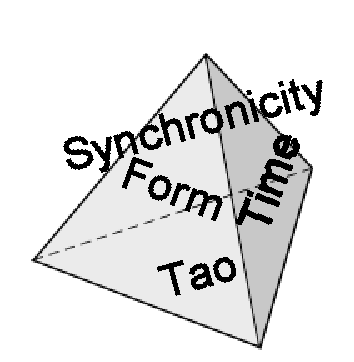 There are approaches that help
understand the difference between mask and child. Astrology offers the tools,
but is only for specialists. The Human Design system of Ra Uru
Hu (www.jovianarchive.com
) is a better approach. It uses I Ching astrology to
clearly differentiate between the design (self) and the personality in an
interesting way. In fact nowhere there is this clear indication and separation
of the tow. HDS claims that the inner child characteristics are related to a
date 3 months before the actual birth and comes up with an interesting graph
indicating 9 chakra’s and how the planets influence those chakra’s. There is
the design influence and the personality influence and they relate to the inner
child and mask used in the model in this essay. No other system makes this so
clear and at the same time helps one to differentiate between the two. HDS
clearly helps to see the inner child qualities/focus, but not the link between
the inner child/self and the mask. The HDS chart here shows how astrological
data are translated via the I-Ching hexagrams into
chakra energies.
There are approaches that help
understand the difference between mask and child. Astrology offers the tools,
but is only for specialists. The Human Design system of Ra Uru
Hu (www.jovianarchive.com
) is a better approach. It uses I Ching astrology to
clearly differentiate between the design (self) and the personality in an
interesting way. In fact nowhere there is this clear indication and separation
of the tow. HDS claims that the inner child characteristics are related to a
date 3 months before the actual birth and comes up with an interesting graph
indicating 9 chakra’s and how the planets influence those chakra’s. There is
the design influence and the personality influence and they relate to the inner
child and mask used in the model in this essay. No other system makes this so
clear and at the same time helps one to differentiate between the two. HDS
clearly helps to see the inner child qualities/focus, but not the link between
the inner child/self and the mask. The HDS chart here shows how astrological
data are translated via the I-Ching hexagrams into
chakra energies.
Under construction:
Wetstone:
Jung’s understanding, the shadow
Wetstone: Mysticism
Wetstone: Kant’s Verstand-Vernunft: there is no bridge
between Theology and Science/Philosophy
Wetstone: the transpersonal psychology
Wetstone: existential therapies
Wetstone: the great traditions, Vedic/Buddhism
Wetstone: astrology
I will end
with a message that appeared on my email and it quite an encouragement to
engage in this struggle with our shadow.
This is a work in progress,
more to follow
Luc Sala. Amsterdam, 2007-08-26